
Baby Backs vs. Spare Ribs
Baby Back Ribs vs. Spare Ribs: Which Are Better?
One of the more common questions we hear in the shop is, “Which ribs are better—baby back ribs or spare ribs?” The question came up again and again leading up to the Fourth of July, which inspired this article.
The truth is, there isn’t a right or wrong answer. The best rib often depends on personal preference. I know plenty of competitive barbecue cooks who swear by spare ribs. On the other hand, we tend to sell more baby back ribs here at Old Station Craft Meats. Before deciding which is better, it helps to understand where each cut comes from and what makes them different.
Where Do They Come From?
As you can see in the diagram below, baby back ribs come from higher up on the hog, along the backbone. The pork loin sits directly on top of these bones. If the loin remains attached, these bones become part of your pork chops. When the loin is removed, what remains is a rack of baby back ribs.
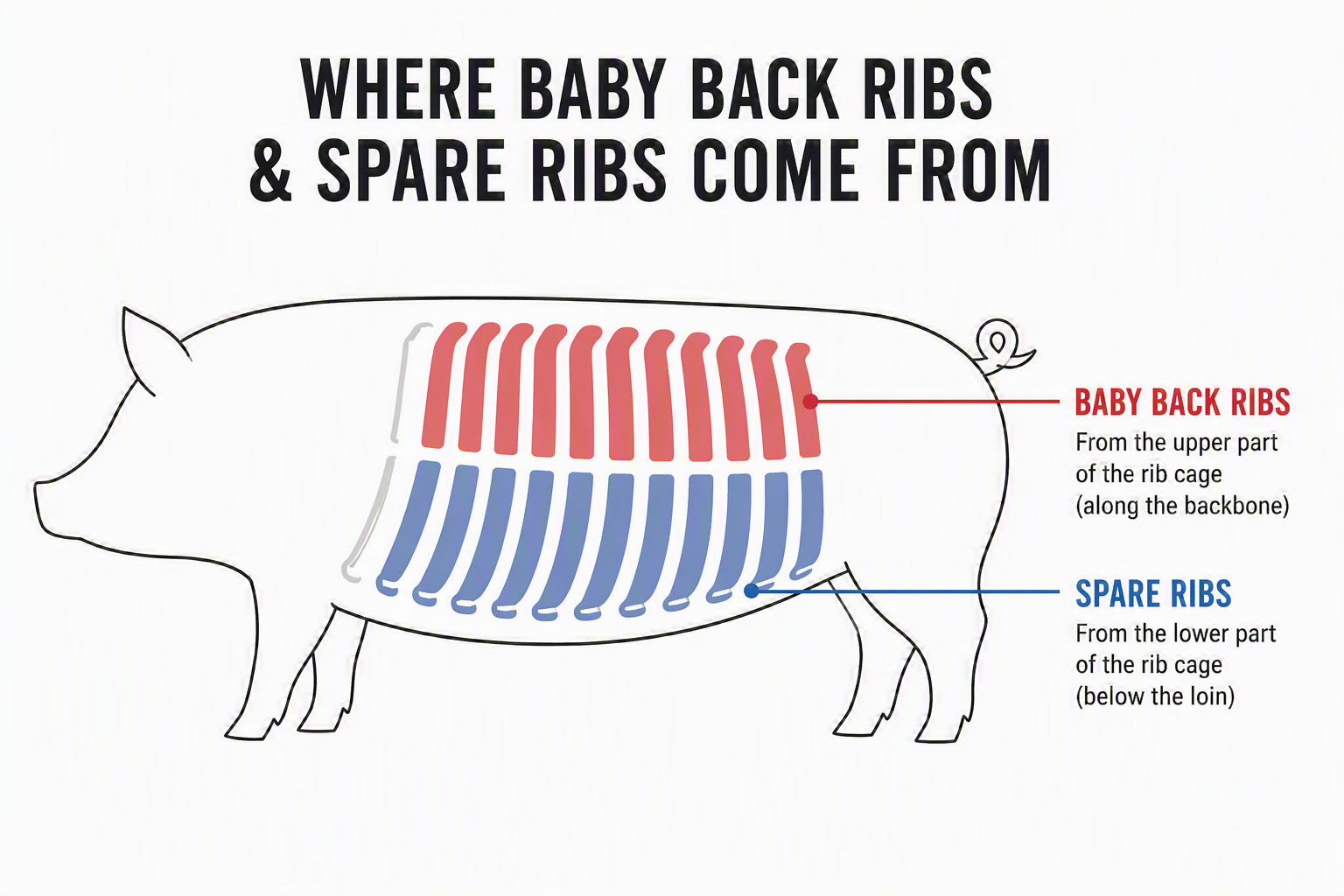
Because baby back ribs come from the loin area, they tend to be:
- Leaner
- Meatier
- More tender
- Made up entirely of solid rib bones
At first glance, that sounds like an easy winner. More meat and less fat—what’s not to love?
The answer lies in the spare ribs.
Spare ribs come from farther down the side of the hog. This area sits beneath the pork belly—the same section we use to make bacon. Because of their location, spare ribs contain more fat and connective tissue, which contributes significantly to their flavor and moisture.
While spare ribs generally contain less meat than baby backs, many barbecue enthusiasts prefer them because they:
- Stay moist during long cooks
- Develop richer flavor
- Have more intramuscular fat
- Hold up well to smoking
Why Are Spare Ribs Different?
One reason some people prefer baby backs is that spare ribs can be a little messier to eat.
As the rib bones approach the sternum, they begin transitioning into cartilage. Some of these bones are partially connected, which can make them slightly less uniform than baby backs. However, the same characteristics that make them a little more challenging to eat are also part of what gives them such great flavor and moisture.
In other words, the extra fat and connective tissue that some people avoid are exactly what many pitmasters are looking for.
What About St. Louis Style Ribs?
Many customers are surprised to learn that spare ribs and St. Louis ribs are essentially the same cut.
A St. Louis rack starts as a full spare rib rack. The difference is that the lower portion containing most of the cartilage and irregular edges is trimmed away, creating a neat rectangular shape.
The result is a rack that:
- Cooks more evenly
- Has a more uniform appearance
- Is easier to slice and serve
For many backyard cooks, St. Louis ribs offer the best of both worlds—the flavor of spare ribs with a cleaner presentation.
How Did They Get Their Names?
The names have interesting origins.
Baby back ribs get their name from their location and size. They run along the back of the hog, making them "back ribs," and the word "baby" refers to their shorter bones compared to spare ribs—not to the age of the hog.
Many people assume spare ribs are called "spare" because they're the leftover ribs after other cuts are removed. While that sounds logical, the name actually has roots in Germany. The original term was ribbesper or rippenspeer, meaning "spear ribs," a reference to cooking them on a spit or spear over a fire.
St. Louis style ribs were popularized by meat packers and butchers in St. Louis during the 1950s and 1960s, who standardized the trimming style that we still use today.
So Which Is Better?
That’s a question only you can answer.
If you like a leaner, meatier rib with smaller bones, baby backs may be your favorite.
If you value rich flavor, moisture, and classic barbecue character, spare ribs—or their trimmed cousin, the St. Louis rib—might be more your style.
Personally, I think they're both worth trying.
One Last Thing…
Both baby back ribs and spare ribs naturally have a membrane on the bone side of the rack. Many cooks remove this membrane before cooking because it can become tough and chewy.
Here at Old Station Craft Meats, we remove that membrane for you. So if you purchase ribs from us, don't waste time trying to find and peel it off—it's already been taken care of.
Whether you prefer baby backs, spare ribs, or St. Louis style ribs, we're happy to help you find the right rack for your next cookout. Stop by the shop and give them a try—you might just discover a new favorite.
— Old Station Craft Meats
Quality meats, knowledgeable service, and a passion for great barbecue.