
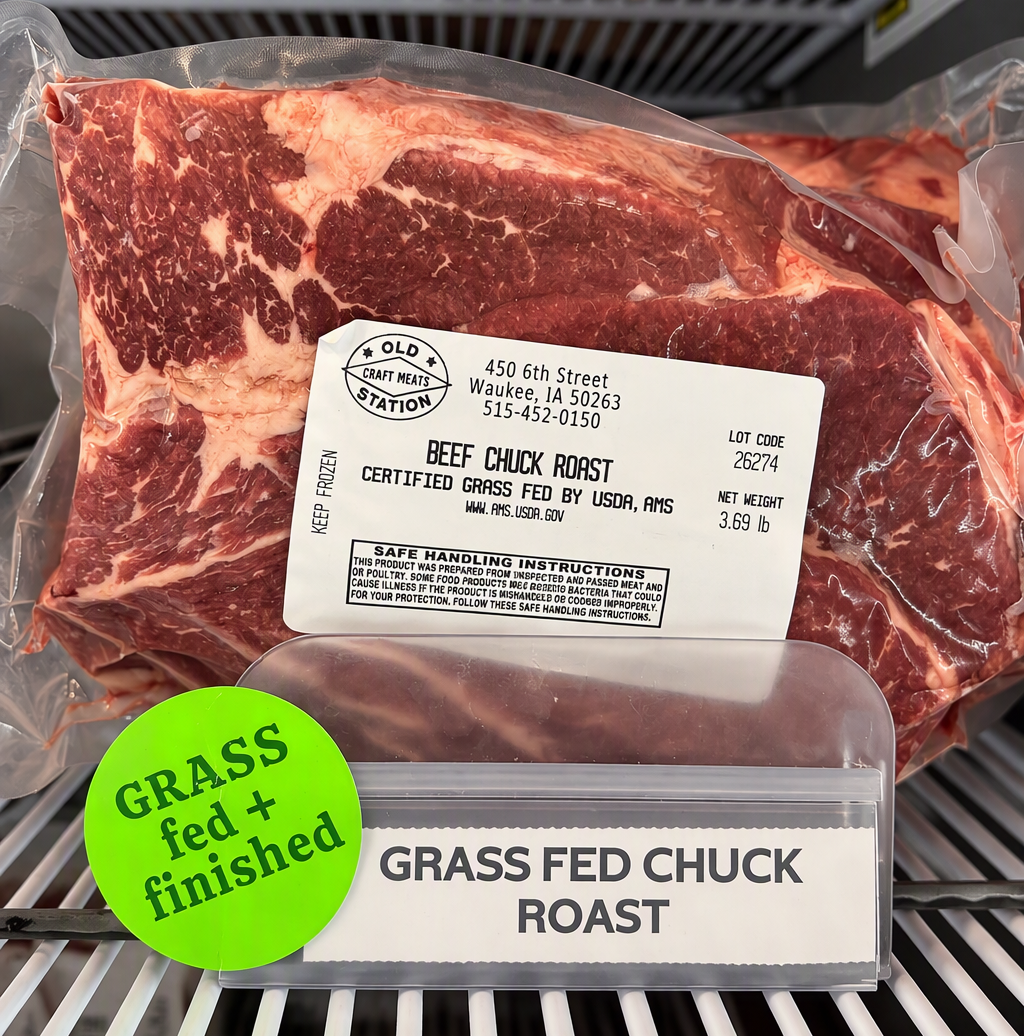
Walk through the meat aisle today and it can feel like you need a glossary.
Organic. Grass-fed. Grass-finished. Natural. No antibiotics. No added hormones. Cage-free. Free-range. Pasture-raised.
They all sound good. But what do they actually mean? And, perhaps more importantly, which of them matter to you?
That second question is something we think about a lot at Old Station Craft Meats.
When I opened Old Station, I felt like consumers had become overwhelmed by the number of claims and certifications attached to meat. When you're not sure what all those terms mean, it's easy to assume you need to go all the way to the far end of the spectrum, often USDA Organic, to get the things you're looking for.
Organic may absolutely be the right choice for some customers. But it isn't necessarily the only way to get the characteristics that are important to you.
Maybe your biggest concern is antibiotics. Maybe it's how the animal was fed. Maybe access to pasture is important to you, or perhaps animal-welfare practices are at the top of your list. Maybe you simply want to know more about where your meat came from and how the animal was raised.
Those are different priorities, and that's where understanding the labels becomes useful.
Think of it as a spectrum
Instead of thinking about meat as simply "conventional" on one side and "organic" on the other, I think it's more helpful to consider the individual characteristics you're trying to buy.
You might picture it something like this:
Conventional → Specific Production Practices → Third-Party Certifications → USDA Organic
As you move along that spectrum, you're generally asking the producer to meet additional requirements. But you may discover that the things that matter most to your family don't require checking every box at once.
That's part of the value we want to provide at Old Station Craft Meats. We're not here to tell you which labels you should care about. We want to help you understand what they mean so you can spend your food dollars on the things you actually care about.
So, let's decode some of the language you're likely to encounter.
Natural
"Natural" might be one of the easiest claims to misunderstand. Most of us see that word on a package and instinctively think, That must be better.
But "natural" isn't really a claim about the animal or the farm. It's primarily about the meat and how it was processed. USDA guidance describes natural meat and poultry products as minimally processed with no artificial ingredients.
In other words, don't read "natural" as meaning pasture-raised, grass-fed, or anything else about how the animal lived. It tells you something about the product, not necessarily the production practices used to raise the animal.
Grass-Fed & Grass-Finished
Here's a pair of terms that can be confusing because they sound like they should mean almost the same thing.
You might assume grass-fed simply means the animal ate grass at some point during its life. But USDA guidance is much more specific. For cattle, a grass-fed claim means the animal was fed forage after weaning rather than grain or grain by-products.
Grass-finished is different. It describes the diet during the finishing period and doesn't necessarily tell you what the animal ate earlier in life. An animal could have eaten grain earlier and then been finished on grass.
So why do we use both terms at our shop?
Because we know there's a lot of confusion around these claims. We label our beef grass-fed and grass-finished to make it clear that our cattle were raised on a forage-based diet after weaning and remained on that diet through finishing.
While "grass-fed" carries the more specific meaning under USDA guidance, putting the two terms together answers the question customers often really want to ask:
Was the animal switched to a grain-based diet for finishing?
In our case, the answer is no.
So don't assume "grass-finished" is simply a stronger version of "grass-fed." Each term tells you something different, and understanding the distinction helps you know what you're actually buying.
No Antibiotics & No Added Hormones
These claims are a little more straightforward, although there's still some fine print worth understanding.
Years ago, medically important antibiotics could be used in livestock feed and water not only for animal health but also for production purposes such as promoting growth or improving feed efficiency. Concerns about antimicrobial resistance helped drive changes in those practices. Today, medically important antibiotics can no longer be used for growth promotion or feed efficiency, and their therapeutic use in feed or water is under veterinary oversight.
That's an important distinction because antibiotics themselves aren't inherently bad. They're valuable animal-health tools. If an animal becomes sick, it may need an antibiotic, just as we sometimes do. The issue is using these medicines responsibly and when appropriate.
No added hormones addresses something different.
In cattle production, hormones may be used to promote more efficient growth, helping cattle gain weight with less feed. But here's where reading the label becomes important: a hormone claim doesn't mean the same thing for every species.
For example, federal regulations do not approve hormones for use in poultry. So seeing "no added hormones" on a package of chicken doesn't distinguish that chicken from other chicken in quite the same way such a claim can distinguish one beef product from another.
That's a good example of why understanding a label can be just as important as seeing it.
Cage-Free, Free-Range & Pasture-Raised
These three terms are often lumped together, but they don't mean the same thing.
Cage-free means the animals or birds have been able to move around without being confined to cages or crates. That may be in a building or an enclosure. The important thing to understand is that cage-free does not necessarily mean outdoors.
A cage-free bird, for example, may still live inside a building.
Free-range takes the idea a step further. For poultry, it indicates access to an outdoor area. Michigan State University Extension notes that free-range is regulated by USDA for poultry but not in the same way for beef, pork, or lamb.
Then there's pasture-raised.
Michigan State University Extension notes that pasture-raised isn't the same as free-range and isn't defined by USDA. It describes a production system and is a term often associated with smaller producers, particularly pastured-poultry operations.
That's an important distinction. Having access to the outdoors isn't necessarily the same thing as being raised on pasture.
When you see "pasture-raised," it's worth learning more about the producer and what that particular claim means on their farm.
Put simply:
Cage-free tells you something about confinement.
Free-range tells you something about outdoor access.
Pasture-raised tells you something about the producer's production system, but it is worth asking exactly how that producer defines it.
Organic
Finally, there's organic, which is probably the broadest claim we've covered.
Unlike many of the individual claims above, organic isn't telling you just one thing about how an animal was raised. Instead, it brings a number of production standards together under one USDA certification program.
Organic livestock must receive certified organic feed and forage, cannot be raised with antibiotics or added growth hormones, and must be provided living conditions that accommodate their health and natural behaviors. Those requirements include outdoor access, while ruminants such as cattle and sheep have additional pasture requirements. Organic producers also maintain records and undergo inspections to verify compliance with the organic standards.
Think of organic as an umbrella that brings a number of production practices together under one certification.
But here's the point I hope you take away from this article:
You don't necessarily have to buy that entire umbrella if there are only one or two things underneath it that are especially important to you.
If avoiding antibiotics or added growth hormones is your priority, look for claims addressing those practices. If outdoor access and living conditions matter most to you, learn what the claims around those practices actually require. If diet is your priority, pay particular attention to the feeding claims.
There's nothing wrong with choosing organic because you want the entire package. But there's also nothing wrong with deciding that certain individual production practices matter more to you than others.
Read the label, then decide what matters to you
Ultimately, there isn't one label that tells every shopper which package of meat is "best."
And I think that's a good thing.
Our goal at Old Station Craft Meats isn't to hand you a checklist of labels you're supposed to look for. It's to help take some of the mystery out of them.
Because once you understand what the words actually mean, the meat case becomes a little less intimidating. You can stop paying for claims simply because they sound good and start looking for the production practices that actually matter to you and your family.
That's what an informed choice should look like.
Sources
U.S. Department of Agriculture, Food Safety and Inspection Service. “Meat and Poultry Labeling Terms.”
U.S. Department of Agriculture, Food Safety and Inspection Service. “Claims Guidance.”
U.S. Department of Agriculture, Food Safety and Inspection Service. “FSIS Guideline on Substantiating Animal-Raising or Environment-Related Labeling Claims.” August 2024.
U.S. Department of Agriculture, Food Safety and Inspection Service. “What Is ‘Grass Fed’ Meat?”
Schweihofer, Jeannine. Michigan State University Extension. “Animal Raising Claims Can Be Confusing on Food Labels.”