

If it seems like everyone is talking about protein lately, you’re not imagining it.
We’ve certainly noticed it at Old Station Craft Meats. According to Kansas State University agricultural economist Glynn Tonsor, the average American is eating 29 pounds more beef, pork, and chicken per year than 15 years ago. That’s a remarkable shift, and it raises an interesting question: Why are Americans placing such a priority on protein?
There are likely several factors at work.
The growing use of GLP-1 medications has brought more attention to protein as people become increasingly intentional about what they eat. At the same time, federal nutrition guidance has moved protein closer to the center of the conversation.
In January, the U.S. Department of Health and Human Services and USDA released the Dietary Guidelines for Americans, 2025–2030. The new guidelines emphasize whole, nutrient-dense foods and specifically prioritize a variety of high-quality protein foods, including eggs, poultry, seafood, red meat and plant-based sources.
All of this got me thinking about a pretty simple question:
If we’re going to prioritize protein, what does a gram of protein actually cost us?
And I don’t just mean in dollars. I mean in calories, too.
Putting Protein to the Test
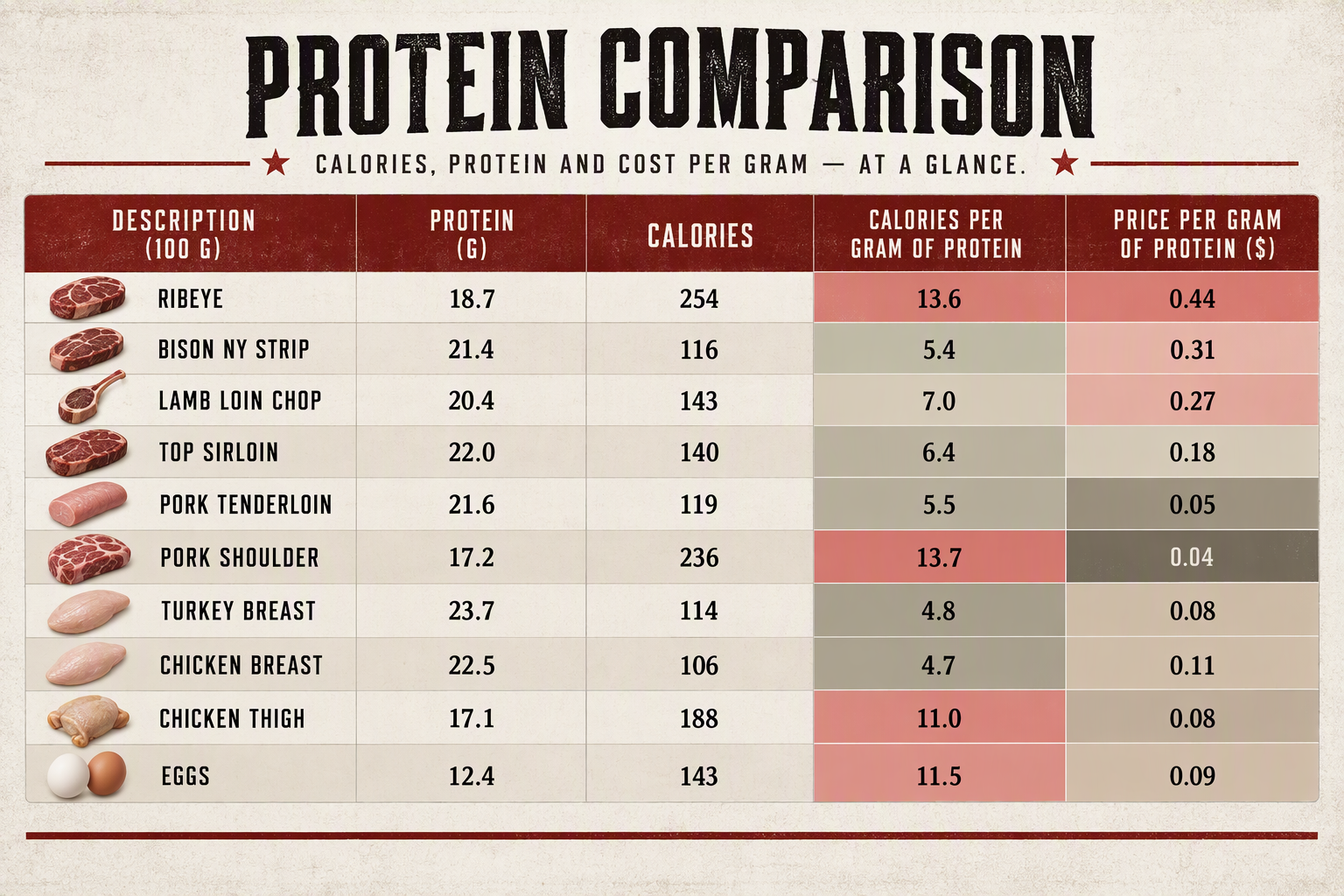
The graphic above compares several common protein sources on an equal basis: 100 grams of each food.
The first columns show how many grams of protein each provides. The two columns on the right take the comparison a step further, showing calories per gram of protein and price per gram of protein.
Some of the results probably won’t surprise you.
Pork tenderloin, turkey breast and chicken breast all deliver a lot of protein for relatively few calories. In our comparison, chicken breast comes in at just 4.7 calories per gram of protein, turkey breast at 4.8, and pork tenderloin at 5.5.
They perform well on cost, too. Pork tenderloin comes in at about $0.05 per gram of protein, turkey breast at $0.08, and chicken breast at $0.11.
For someone looking strictly at protein efficiency, all three make a compelling case.
But that’s where this gets interesting.
If Beef Costs More, Why Do We Still Want It?
Normally, when the price of one protein rises dramatically, we expect consumers to start substituting something less expensive.
Economists call this relationship cross-price elasticity. If beef becomes considerably more expensive, for example, we would expect some consumers to shift their purchases toward pork or chicken.
But consumers don't make food decisions based on price alone.
Glynn Tonsor and the team behind Kansas State University’s Meat Demand Monitor have been studying what Americans buy and why they buy it. That research points toward an important part of the protein equation that our graphic can't measure: the eating experience.
Research from Glynn Tonsor identifies taste, freshness and safety as important factors influencing protein purchasing decisions.
And those of us who love good meat understand that instinctively.
There’s More to Protein Than the Number
Take the ribeye.
If our only objective were maximizing protein while minimizing calories and cost, ribeye wouldn't win this particular comparison.
But nobody chooses a great ribeye because it is the mathematically optimal way to consume a gram of protein.
We choose it because of the experience.
Flavor. Tenderness. Juiciness. The aroma coming off the grill. That first bite of a beautifully cooked steak.
That's an important distinction in today's protein conversation. Consumers may be thinking more carefully about how much protein they eat, but value doesn't necessarily mean finding the cheapest gram of protein.
It can also mean making the food we do eat worth eating.
That's why there really isn't one "best" protein. Pork tenderloin, turkey breast and chicken breast offer tremendous efficiency. Other cuts and proteins bring different combinations of flavor, richness, tenderness and experience to the table.
At Old Station Craft Meats, we think there’s room for all of it.
Because protein may be having its moment.
But great meat has always been about more than a number.
Sources:
U.S. Department of Agriculture, FoodData Central Food Search
U.S. Department of Health and Human Services
Kansas State University: Meat Demand Monitor